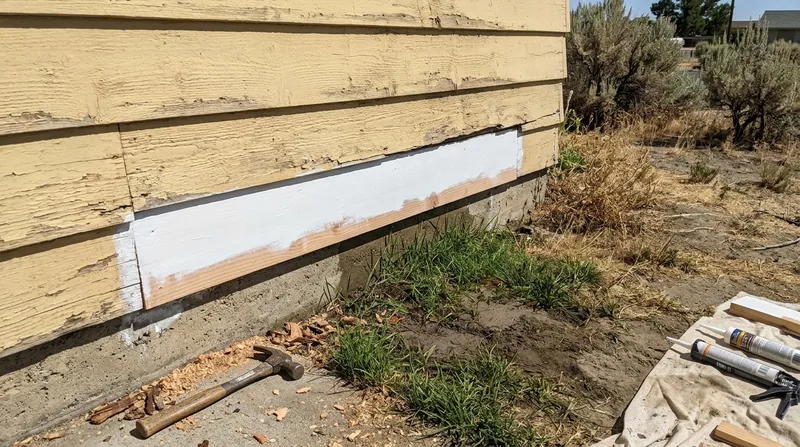




Wood rot and dry rot repair in Kennewick is rarely about rain. In the Tri-Cities shrub-steppe, where annual precipitation barely reaches 7 inches, the real culprit is lawn irrigation. Overspray soaks the bottoms of wood siding, trim, sill plates, and deck ledgers every summer, then freeze-thaw cycles in winter finish the damage. By spring, soft wood, paint failure, and structural decay appear where the sprinkler spray reached. We cut out the rotted wood, treat what remains, and rebuild with rot-resistant lumber. That is a permanent repair, not a cosmetic patch or temporary seal.
Why Wood Rot Matters in Kennewick's Dry Climate
Kennewick homeowners often assume their dry climate protects wood from rot. That assumption is wrong. The real threat is not rainfall, it is the contrast between summer irrigation and winter freeze-thaw. Water sits in wood grain and capillaries where sprinklers overspray siding bottoms, fence posts, and sill plates. When temperatures drop below freezing, that water expands and splits the wood fibers. Spring thaw brings more moisture into the cracks. Over two to three seasons, fungal decay colonizes the damaged wood, and structural integrity declines. What starts as paint peeling and soft spots becomes floor sag, wall movement, or deck ledger failure.
- Lawn sprinkler overspray is the dominant cause of rot in Kennewick homes, not roof leaks or ground moisture.
- Freeze-thaw cycles exploit moisture already in the wood, accelerating decay faster than steady-state wetness would.
- Sill plates, rim joists, and deck ledgers fastened directly to masonry or soil absorb capillary moisture year-round.
- Soft wood visible at the surface usually means decay has progressed deep into framing behind the paint.
Early detection and removal of rotted wood stops the spread and avoids far more expensive framing repairs later.
Key info: A 1950s frame home in downtown Kennewick with vinyl siding and a lawn sprinkler system typically shows rot at the sill plate and bottom 12 inches of wall studs within 15 to 20 years if overspray is not redirected. Richland's alphabet houses and Pasco ranch homes built with wood siding and wood trim face the same risk in the same timeframe.
For more on related structural damage, see our floor joist and subfloor repair page, which often follows untreated rot in sill plates.
How We Repair Wood Rot: Step by Step in Kennewick Homes
Our approach is straightforward. We identify the extent of decay, cut out all compromised wood, treat the remaining structure to prevent new growth, and rebuild with pressure-treated lumber or naturally rot-resistant species. We do not patch over soft wood or seal decay in place. That fails within months. Instead, we remove the problem, address the moisture source, and install durable replacement material.
- We inspect the damage with a moisture meter and screwdriver to determine how deep decay has penetrated into framing.
- We cut out all soft, discolored, or spongy wood back to sound material, leaving clean edges for new lumber to bond properly.
- We treat exposed framing with a wood preservative to inhibit fungal and insect activity in the remaining wood.
- We install new framing lumber, sill plates, or trim using pressure-treated stock or naturally durable species like redwood or Douglas fir heartwood.
- We seal new wood with paint or stain appropriate to the exposure and finish the joint to match existing trim or casing.
The entire process takes one to three days for most sill plate or trim repairs, longer for structural members like rim joists or floor joists.
Local example: A 1960s split-level in West Richland with wood siding and a sprinkler line running along the foundation showed soft wood at the sill plate and bottom two courses of studs on the east side. We removed 8 linear feet of rotted sill plate and 4 studs, treated the rim joist, and installed new pressure-treated lumber and siding. The job took two days and cost $1,850. Redirecting the sprinkler head prevented recurrence.
Related structural work, such as sistering a weakened floor joist, is described in detail on our framing and structural carpentry page.
Wood Rot Repair Methods and When to Use Each
| Approach | Description | Best for |
|---|---|---|
| Full removal and replacement | Cut out all rotted wood and install new pressure-treated lumber or rot-resistant species from end to end. | Sill plates, rim joists, trim, and fascia where decay is widespread or affects structural members. |
| Localized removal with sister framing | Remove rotted section of a floor joist or beam and bolt a new pressure-treated member alongside the remaining sound wood. | Floor joists, beams, and headers where only a portion is compromised and load-bearing capacity must be restored. |
| Wood preservative treatment only | Apply liquid fungicide and insecticide to exposed framing after decay is removed, with no replacement lumber needed. | Preventing new rot in sound wood adjacent to areas where decay was removed; not a standalone repair for active damage. |
| Siding and trim replacement | Remove rotted siding boards or exterior trim and install new pressure-treated or naturally durable boards, painted or stained. | Fascia, soffit, trim boards, and siding bottoms where surface damage is visible but underlying framing remains sound. |
Wood Rot and Dry Rot Repair Cost in Kennewick: What to Expect
Rot repair pricing in Kennewick depends on the size of the affected area, how deep decay has penetrated, and whether structural members or just exterior trim are involved. A small sill plate repair on a 1950s home might start at $650 to $900. Larger jobs involving multiple studs, joists, or beams, or work that requires temporary support or bracing, run $1,500 to $4,000 or more. On-site inspection is essential because soft wood is deceptive. What looks like a 2-foot section of decay often extends 3 to 4 feet when we start cutting.
- Extent of decay measured in linear feet or number of members affected is the largest cost driver, not the severity of surface damage.
- Access to the rotted area, such as crawl space clearance or removal of exterior finishes, adds labor and time.
- Structural members like floor joists or beams require temporary support during removal and replacement, increasing cost and complexity.
- Pressure-treated lumber and naturally durable species cost more than standard framing stock but last decades longer in Kennewick's freeze-thaw climate.
- Moisture source mitigation, such as redirecting sprinkler spray or improving drainage, may be recommended to prevent recurrence.
We recommend getting two or three estimates from local carpenters so you can compare scope, material choices, and price. Visit our pricing page for more detail on factors that affect cost, and call us at (509) 581-4504 for a free estimate tailored to your home.
Wood Rot and Dry Rot Repair Near Me: What Kennewick Homeowners Should Know When Hiring
Hiring a carpenter for rot repair is straightforward if you know what to look for. The contractor should be fully insured, provide references from recent local jobs, and explain exactly what wood will be removed and what will replace it. Ask whether they will treat remaining framing with a wood preservative and whether they recommend addressing the moisture source (often a sprinkler adjustment). Get the estimate in writing, including material and labor costs. Do not accept vague language like "we'll seal it" or "we'll treat the rot." Rot cannot be treated in place; it must be removed.
- Verify that the contractor is fully insured for general liability and workers compensation before work begins.
- Ask for at least two references from Kennewick or nearby homes where rot repair was completed in the past 18 months.
- Request a written estimate that specifies the linear feet or number of members to be replaced and the grade of replacement lumber.
- Clarify whether the estimate includes treatment of adjacent sound wood and finishing (paint, stain, or siding installation).
- Understand whether a permit is required; structural work on load-bearing members may need approval from the local building department.
Contact us at our contact page to schedule a free estimate. We respond within 24 hours and can often visit within three to five business days.
Wood Rot & Dry Rot Repair in Kennewick: Pricing Guide
| Service | Price | Details |
|---|---|---|
| Sill plate or trim rot repair | Starting at $650 | Removal and replacement of rotted wood in exterior trim, fascia, or sill plate up to 6 linear feet with material and finishing included |
| Larger sill plate or multiple studs | Starting at $1,500 | Removal of rotted sill plate and one to four studs, treatment of rim joist, installation of pressure-treated lumber, and exterior finishing |
| Floor joist or beam repair with sistering | Starting at $2,200 | Removal of rotted section, temporary support installation, sister joist bolted to sound framing, and treatment of adjacent wood |
| Large-scale structural rot or multiple areas | On estimate | Complex jobs involving multiple floor joists, beams, or load-bearing walls require site inspection to determine temporary bracing and exact scope |
| Moisture source mitigation | Included or separate | Sprinkler redirection, drainage improvement, or ventilation adjustment to prevent rot recurrence may be recommended and quoted separately |
| Free estimate | No obligation | Response within 24 hours at (509) 581-4504, includes site visit, assessment of decay depth, and written repair proposal with pricing |
Indicative pricing, the exact cost depends on square footage, finish, and site access. Free personalized estimate within 24h at (509) 581-4504.


