Understanding House Settlement in the Tri-Cities Region
If you own a home in Kennewick, you may have noticed something unsettling: doors that won't close properly, floors that feel slightly tilted, or windows that stick in their frames. These aren't signs of poor construction or imminent disaster. Instead, they're often the natural result of house settlement, a process that occurs beneath virtually every home built on soil.
House settlement happens when the soil supporting your foundation compacts and shifts over time. This is especially common in the Tri-Cities area, where the underlying geology consists of silt, clay, and sand deposits that respond to changes in moisture, temperature, and the weight of the structure above. When your home was first built, the soil beneath it was disturbed during excavation and foundation work. Over years and decades, that soil naturally consolidates, sometimes unevenly, causing your house to shift slightly. While minor settlement is normal and expected, excessive or uneven settlement can lead to structural issues that require professional attention.
Why Doors Stick and Won't Close Properly
One of the most common complaints from homeowners in Kennewick is that interior and exterior doors suddenly stick or refuse to close smoothly. This frustrating problem is almost always connected to foundation settlement. When your house settles unevenly, the wooden frames that hold your doors shift out of their original square alignment. A door frame that was perfectly plumb and level when installed may now be slightly tilted or warped, causing the door to bind against the frame as it swings.
The problem is compounded by the fact that wood naturally expands and contracts with changes in humidity and temperature. During the hot, dry summers in the Tri-Cities, wood loses moisture and shrinks. During cooler months, it absorbs moisture and swells. When combined with foundation movement, these seasonal changes can make door operation increasingly difficult. The good news is that sticking doors are usually easy to diagnose and fix. A professional carpenter can assess whether the issue is simply a matter of adjusting hinges, planing the door edge, or if it signals a more serious foundation problem that needs investigation.
Uneven Floor Repair: When Settlement Becomes Visible
Sloping or uneven floors are perhaps the most obvious sign that your home has settled unevenly. You might notice that a marble rolls across your living room floor, or that you feel like you're walking slightly downhill in certain rooms. While minor slopes of less than one-quarter inch over ten feet are generally considered acceptable and don't require immediate action, more pronounced slopes can indicate that one part of your foundation has settled significantly more than another.
Uneven settlement can occur for several reasons. Soil on one side of your home may be more compressible than soil on the other side. Water drainage patterns around your foundation can cause certain areas to settle more than others. Tree roots near your foundation can extract moisture from the soil, causing it to shrink and settle. In some cases, inadequate soil preparation before the foundation was poured can lead to differential settlement years later. If you're concerned about sloping floors, it's important to have a structural assessment. Sometimes, Floor Joist & Subfloor Repair is necessary to stabilize the structure and prevent further damage to walls, plumbing, and electrical systems.
The Role of Soil Composition in Tri-Cities Settlement Patterns
The Tri-Cities region sits on a unique geological foundation that plays a significant role in how homes settle. The area was shaped by ancient Missoula Floods, which deposited layers of silt, sand, and gravel across the landscape. These soils are highly variable, and their behavior depends heavily on moisture content. Silt and clay-rich soils are particularly prone to settlement because they compact significantly when loaded with the weight of a house. Sandy soils tend to settle more uniformly, while clay soils can shrink dramatically when they dry out.
Moisture is the key variable. When soil contains adequate moisture, it supports your foundation more consistently. But during dry periods, especially the long, hot summers common to Kennewick, the soil loses water and shrinks. This shrinkage isn't uniform. Soil directly beneath your house may dry out more slowly than soil at the edges, or vice versa depending on drainage patterns, landscaping, and irrigation practices. This differential drying and shrinking is why some homes experience uneven settlement while others settle uniformly. Understanding your local soil conditions can help explain why your home is settling the way it is and what preventive measures might help slow the process.
When Settlement Leads to Structural Damage: Wood Rot and Beam Issues
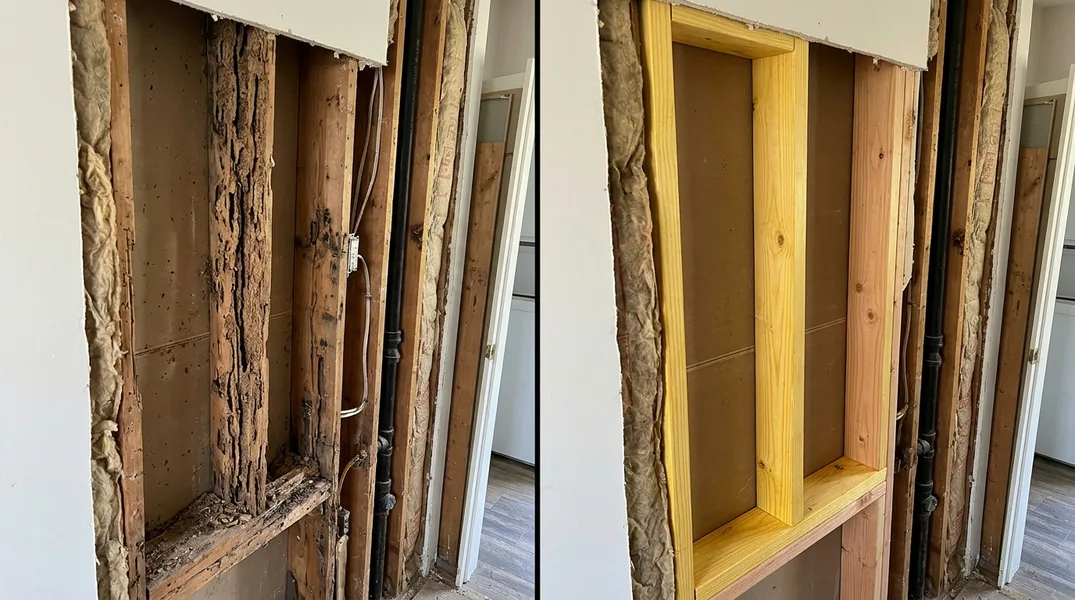
While doors sticking and floors sloping are annoying, the real danger from house settlement comes when it creates conditions that lead to structural damage. Uneven settlement can cause cracks in your foundation, which allow water to seep into basements and crawl spaces. This moisture creates the perfect environment for Wood Rot & Dry Rot Repair, a serious problem that weakens the wooden beams, joists, and framing that hold your house together. Wood rot is particularly insidious because it often develops hidden inside walls and beneath floors, where you can't see it until significant damage has already occurred.
Settlement can also cause beams to bend or crack under uneven loads, and in some cases, Beam Replacement & Load-Bearing Wall Removal becomes necessary to restore structural integrity. If your home is experiencing significant settlement, it's crucial to have a professional inspection to determine whether there's underlying damage to the foundation, framing, or support beams. Ignoring settlement-related damage can lead to much more expensive repairs down the road. The longer moisture and structural problems persist, the more damage accumulates, and the more costly the solution becomes.
What to Do If Your Home Is Settling: Getting Professional Help
If you've noticed sticking doors, sloping floors, or other signs of settlement in your home, the first step is to have a professional assessment. A qualified carpenter or structural inspector can evaluate the extent of settlement, identify the underlying causes, and recommend appropriate repairs. Some settlement is normal and requires no action. Other settlement patterns indicate problems that need to be addressed to prevent further damage.
At Kennewick Carpentry, we help homeowners throughout the area understand what's happening beneath their homes and what needs to be fixed. We can assess whether your doors and floors are simply cosmetic issues related to normal settlement, or whether they're warning signs of more serious structural problems. If repairs are needed, we have the expertise to handle everything from adjusting doors and leveling floors to addressing the underlying foundation and structural issues that may be causing the settlement. We recommend getting a free estimate to understand the scope of work needed and the pricing for repairs. You can reach us at (509) 581-4504 to schedule an inspection and get peace of mind about your home's condition.
Looking for a professional carpentry contractor in Kennewick? Kennewick Carpentry responds fast for all your carpentry needs.
Get a Free QuoteOur services: Wood Rot & Dry Rot Repair · Termite Damage Repair · Floor Joist & Subfloor Repair